
Boston 80s Band 007 (Dub7): Overview
Background and Style
Boston’s underground music scene in the late 1970s was shaped by a core of raw, guitar-driven bands that emerged in the wake of proto-punk and garage rock. Groups like Willie "Loco" Alexander and the Boom Boom Band, The Real Kids, DMZ, and the Nervous Eaters played a central role in establishing Boston as a regional punk hub. These acts leaned heavily into American rock traditions, combining stripped-down arrangements with elements of glam, garage revivalism, and early punk attitude. Their shows often took place in smaller venues like The Rat in Kenmore Square and fostered an audience hungry for energy, immediacy, and local identity.
As the decade turned, the scene broadened. Bands like Unnatural Axe, LaPeste, and The Girls pushed toward a more explicitly punk identity, more stylistically aligned with the emerging international punk circuit. By 1979, Boston's underground rock scene had developed a dense and fast-moving ecosystem of bands, venues, and college radio shows.
By the early 1980s, the scene's growing infrastructure gave rise to a new generation of acts ranging more widely from post-punk to hardcore to power pop. Alongside 007, all kinds of bands--Mission of Burma, The Neighborhoods, Human Sexual Response, and The Outlets, and so many others--were exploring new territory. Some incorporated experimental structures, synth textures, or post-punk minimalism, while others doubled down on melodic songwriting or live theatrics. This period marked a shift toward broader genre experimentation, with influences ranging from British art-punk and reggae to American hardcore. 007 emerged in this environment, drawing from a wide palette that included punk, ska, dub, R&B, and 1960s pop, while maintaining ties to both the more cerebral post-punk groups and the harder-edged punk circuit. They were as at home opening for acts like the Bush Tetras and The Mo-dettes as they were sharing stages and friendships with Circle Jerks, T.S.O.L., and Bad Brains.
Boston Band Identity Before It Became a Global Cliché
Boston’s underground rock culture has always been broader and more layered than the cartoonish image shaped by Celtic-punk bombast in movie soundtracks. That mainstreamed impression is a tiresome distortion of the city’s underground rock DNA. Local identity had long been part of the story—Jonathan Richman was channeling suburban streetscapes and Fenway dreams back when punk was still proto.
But let’s come back to our protagonists, 007. Their lyrics liberally included Boston references—the Dudley bus, Government Center, the Prudential Tower, Boylston Street—and Larry’s vocals carried a distinctly Boston accent that made the city itself feel embedded in the band’s sound.
Maybe it was the influence of London bands like the Jam and the Clash that made it feel natural to mix genres and root the lyrical voice in a particular city. But let’s be clear: those two aspects of a band’s identity don’t automatically go together. At least not necessarily. Still, it was a kind of Zeitgeist. That same year, Future Dads—led by Richie Parsons of Unnatural Axe—put out No Surfin in Dorchester Bay, a tongue-in-cheek surf parody that combined hyperlocal references with retro genre play. It wasn’t punk exactly, but it was unmistakably Boston: mashing up styles, self-aware, and rooted in place. Whatever the cause, 007 also combined both the blending of genres and very local vocals. They didn’t invent either idea, but they showed how the combination could thrive in a Boston context. Proof of concept. The local identity thing, especially, resonated locally. Noticably.
In their final months with original co-frontman Dee Rail, late 1982, 007 overlapped with the rise of Dicky Barrett’s proto-Bosstones bands. Barrett was pulling inspiration from all sides—Boston hardcore, UK punk and ska, and more. But 007 had already modeled a kind of hybrid: ska grooves paired with Boston-centric lyrics and vocal delivery. If it felt like a baton was passed, that’s because it almost was. While 007 shifted direction as Dub7, Barrett took the blend and turned it into something louder, broader, and proudly branded. What had been a creative impulse became a rallying point—a sound and identity built to travel. The Bosstones really turned the combination up to eleven.
In this way, we see that later bands would go on to define Boston’s genre-fusion identity in more visible ways, 007 played a quieter but foundational role. Their style and social positioning were different from the "ska-core" that would come later. 007 was less mosh pit energy, more cosmopolitan edge, informed by post-punk sensibilities and UK music press aesthetics. Crucially, their appeal cut across social lines: 007 drew both collegiate cosmopolitans and local punks from across the social map. They weren’t a niche band for one kind of crowd. They brought together hardcore kids, mod revivalists, ska loyalists, and local weirdos who didn’t care for categories. That sensibility—the possibility of a unified, mixed audience energized by genre collision—was already present in 007’s earliest shows and recordings, well before it became a defining trait of the broader underground band landscape.
While it’s definitely true that later acts like the Mighty Mighty Bosstones and Dropkick Murphys would eventually give that hybrid spirit a more codified public image, there’s no denying that 007 had already tested the chemistry—stylistically and socially—in a way that made such fusion feel natural. Their particular mix drew from ska, punk, mod, R&B, and dub, but also from a fluid, border-crossing posture that made space for overlapping subcultures. If the Bosstones and Dropkicks later made that sensibility louder, broader, and more identified with blokey, townie pride, 007 had already demonstrated its reach—on the same stages, with half the same crowds—with a sound and stance rooted in both deep local knowledge and a wider cultural lens.
So, we see a recognizable pattern of genre blending (in Boston) that connects 007, The Mighty Mighty Bosstones, and The Dropkick Murphys within the evolution of Boston’s underground rock scene. But, as one recent write-up observes,
"The Dropkick Murphys’ sound and image have become so dominant in the public imagination that they often overshadow Boston’s other musical legacies: the arty post-punk of Mission of Burma, the genre-mixing of 007, the synth-pop weirdness of Human Sexual Response, the garage grit of the Real Kids, and many more. It’s not that one version is wrong—it’s just incomplete."
[Source: Perplexity AI, retrieved June 30, 2025.]
Any road, 007’s early role in this progression remains an important, if often underrecognized, part of that story.
Fun facts
- 007, later known as Dub7, was a band whose lineup and sound cut across punk, soul, ska, dub, and R&B, active in Boston in the early 1980s.
- Their music combined punk, mod, post-punk, R&B, 60s pop, ska, and dub influences, often drawing comparisons to the British 2 Tone ska revival bands like The Specials and The English Beat.
- They were known for energetic live shows and for opening for major acts such as The Specials, The English Beat, Bad Manners, and even The Clash in 1982, earning praise from members of The Clash.
Lawrence LaFerla—also known as Wrence, or sometimes Larry “Williams” LaFerla—was the lead vocalist of 007. Larry, along with Steve Harrell (lead guitar) and fellow frontman Dee Rail (bass), was central to the band’s creative direction. All three were songwriters and founding members, along with Garry Miles (drums).
Their eclectic sound and ability to attract diverse audiences influenced younger Boston bands to embrace stylistic diversity. Boston’s next wave of post-punk, ska, and alternative bands, who adopted their genre-mixing approach and live show intensity.
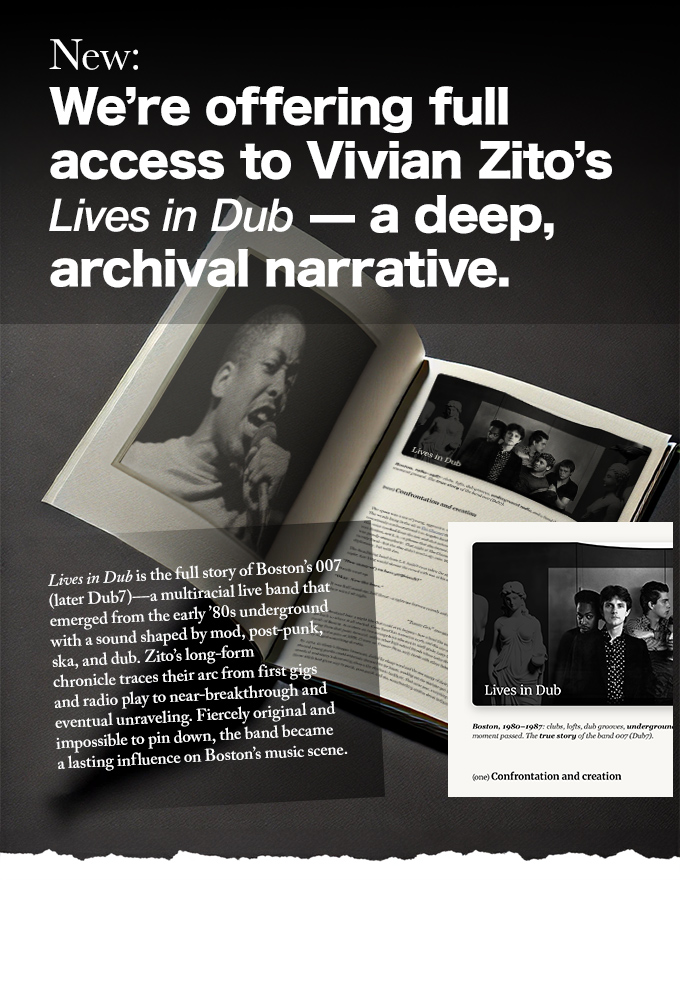
Key Points
- 007/Dub7 played a pivotal role in Boston’s early 80s underground punk scene.
- Their music and style were eclectic, making them hard to categorize but influential among peers and audiences.
- Recent efforts have revived interest in their recordings and history, especially with the rediscovery of lost tracks like “Loosen Up With The Kessels”.
Evolution and Name Change
- In 1982, after Dee Rail’s departure and due to a trademark conflict with United Artists over the “007” name, the band rebranded as Dub7.
- As Dub7, they leaned further into dub and experimental sounds, but struggled to fit into a single scene, making it harder to maintain a consistent following.
Legacy and Releases
- Notable recordings include live performances from 1980–1982 and the single “Gavel Groove”.
- Their song “Loosen Up With The Kessels”, recorded in 1986, was shelved for decades and only released recently, highlighting their continued cult appeal.
- The band dissolved not long after this period, but their genre-mixing approach and live reputation left a lasting mark on the Boston music scene.
- Additional information on their releases is available on MusicBrainz.
Formation
The band that would become known by multiple names – 007, Dub7, and eventually The Kessels – originated in Boston, Massachusetts, around the middle of 1980. Steve Harrell was the one who initially put the band together in 1980. Garry Miles and Lawrence LaFerla (also known as Larry "Williams" LaFerla and later referred to as Mr Kessel) had a long history, having played in bands together since they met in 9th grade in 1975. LaFerla was one of the two front guys, singing and playing backing guitar. The other front guy, Dee Rail, played bass. Garry Miles pounded the drums. Harrell, described as the "Brian Jones of the band" for putting it together, was the lead guitarist and wrote songs along with Rail and Larry. He was also, informallly, like a music director for the band.
Initially, the band was simply called 007. Their early sound was characterized by a blend of genres, described as a hybrid of The Specials, PiL, The Clash, and the Bad Brains. They drew on punk, r&b, 60s pop, and dub. Legendary college radio DJ Peter Voltmeter Holt described 007 as combining "all the disparate elements of new music," including alliances with punks, garage rockers, art rockers, and post-punks. Their early material leaned towards mod/ska.
The period from January 1980 to December 1981 is referred to as "007 splash!" in the band's timeline. Some of their earliest shows took place at The Underground in 1980, just weeks after John Lennon was shot. By 1981, 007 had become a formidable live act known for blending genres effortlessly and having sophisticated live shows with dub mixing and stage lighting. A significant early performance was on August 27, 1981, at the Bradford Ballroom in Boston, where they opened for The Specials on the same night that The Specials disbanded.
Dub7 Era
The band's music continued to evolve. By 1981/1982, contemporary dub elements had found their way into 007's sound.
A pivotal moment came in 1982 when 007 opened for The Clash on their Combat Rock Tour at the Cape Cod Coliseum in August. Four tracks from this show were recorded from the mixing board and are included on the digital album "007 Live In Boston And South Yarmouth: 1980, 1981, 1982". Members of The Clash offered positive feedback; Mick Jones remarked that 007 "sounded like us".
The departure of Dee Rail later in 1982 marked a significant turning point. Rail's split caused the cancellation of a planned East Coast tour where 007 was scheduled to open for The English Beat; The Bangles replaced them on the bill.
The band rebranded from 007 to Dub7 around 1984. This name change was partly necessary because United Artists had trademarked "007" in music publishing. Ken "Kenny" Epps joined on bass and suggested the name "Dub7". The band was strengthened by the addition of John "JG" Goetchius on keyboards. As Dub7, the band incorporated more dub elements and explored a more spaced-out direction.
In 1984, Dub7 released a 7" single, "Gavel Groove" b/w "Federales". The recorded mix of "Gavel Groove" sounded huge, but issues during the vinyl pressing process resulted in the record sounding "small and tinny," described as if played through a walkie talkie. This was a significant letdown for the band. The single was picked up by WBCN and sounded better over the air due to broadcast compression. The "Federales" track was perceived as the "funk" sound that impressed Kosmo Vinyl. They also participated in highly publicized talent contests, reaching the finals of the WBCN Rumble in 1984. In 1985, a track called "Boston Pops" was released on a cassette-only compilation. The Dub7 brand was described as adrift, caught between being poppy and arty.
The Kessels
As the band continued to evolve, they eventually became known as The Kessels. It was a very low-key project that most of the live scene probably didn't even notice. This transformation marked a shift towards a more pop-oriented sound with melodic hooks and refined production. The song "Loosen up with the Kessels," recorded in the mid-1980s, exemplified this new direction. While one source states it was recorded in 1986, others place it in the mid-80s. The recording took place at Polymedia Studio in Boston and was mixed by Tim O'Heir, who later earned a Tony Award and Grammy nomination. O'Heir's work on this track was a significant milestone, marking his transition from commercial jingles to artistic production and connecting him to Fort Apache studio. Despite the effort put into it, "Loosen up with the Kessels" was considered "too pop" for many Boston indie radio stations at the time and was shelved. The band, then known as 007/Dub7, was unable to reach their usual audience with the song. The Kessels lineup featured Steve Harrell on guitar, Mr Kessel (Lawrence LaFerla) on vocals, Matt Elmes on bass, and Garry Miles on drums. The band disbanded not long after shelving this song.
Rediscovery
Years later, band members reconnected through social media. This reconnection sparked the idea of creating an online archive and releasing live audio from the early 1980s. Research was undertaken to reconstruct the band's history and provide context for these releases.
This led to the 2016 digital release titled "007 Live In Boston And South Yarmouth: 1980, 1981, 1982," featuring live performances from that period. The audio quality of some tracks is noted as rough, but they hold historical significance. The album includes tracks from the Bradford Hotel show with The Specials in 1981 and the Cape Cod Coliseum show with The Clash in 1982.
The master tape for "Loosen up with the Kessels" was rediscovered after being lost for over three decades. The tape required specialized restoration, known as "baking," to make it playable, which was successfully performed by a magnetic audiotape restoration expert. The fully restored and freshly mastered version of "Loosen up with the Kessels" was finally released in 2023, available on streaming services. The song's sound has been compared to artists in the psychedelic post-punk realm like Rain Parade. Think Paisley Underground meets Robyn Hitchcock meets the Beatles. An instrumental version was also released.
In 2019, a second remaster of the "Gavel Groove" single was released. The original master tape is lost, so this remaster was created by mixing two different digital recordings captured by strangers from their vinyl copies, restoring the intended "huge" sound through audio engineering techniques.
Legacy
The story of 007/Dub7/The Kessels is acknowledged as potentially just a footnote in the broader history of rock music, but the efforts to preserve and release their recordings ensure their story and music can be heard. The band's journey highlights the challenges of navigating the music industry, evolving sounds, lineup changes, and the enduring power of music rediscovered years later.
007 played seemingly countless gigs across Boston and the surrounding area throughout the early to mid-1980s. Their first show was at Boston College in late 1980, opening for Kenne Highland’s band, and they soon became regulars at The Underground. They went on to perform at Cantones, The Rat (Rathskeller), and nearly every other major venue of the era—Streets, The Channel, Inn Square Men’s Bar, Spit—often sharing bills with bands like The Proletariat, The Neighborhoods, Boys Life, The Outlets, The Peter Dayton Band, Lou Miami and the Kozmetix, Salem66, and The November Group. Both The Del Fuegos and 'Til Tuesday opened for Dub7 in their early days. The full list of acts they played with is impossible to reconstruct precisely, but a randomized sampling gives a sense of the range: The Terrorists, Sleepy LaBeef, Camper Van Beethoven, Jim Carroll, Mikey Dread, Bush Tetras, Gregory Isaacs, The Neats, The Prime Movers, Fear, SSD, Bad Manners, Someone and the Somebodies, Future Dads, The Schemers, The Clash, Joan Jett, Bad Brains, Lone Ranger, Circle Jerks, Peter Tosh, The Bongos, The Young Snakes, Mo-dettes, The Specials, Fabulous Billygoons, and The English Beat—and many others whose names have faded. The range is striking: major-label headliners, underground legends, punk pioneers, art-school experimenters, and fellow locals just trying to break through.
As Dub7, they were the first rock band to play Storyville —and the last before the venue ceased hosting live music. They also shared stages with a strikingly wide range of acts. Though they never toured outside New England (except for one New York gig), their live reputation and genre-defying sound made them a mainstay of Boston’s post-punk scene during its most vibrant years.
Timeline
- 1975: Garry Miles and Lawrence "Larry Williams" LaFerla meet in 9th grade and start playing in bands together.
- Around 1977: Larry and Garry frequently attend local rock/punk shows at The Club on Main Street in Cambridge.
- 1979: They are influenced by the UK mod and ska revivals, particularly the Quadrophenia film and The Specials' first album, incorporating these influences into their music. Larry writes the ska punk song "Teenage Captive" around this time.
- Middle of 1980: Steve Harrell forms the band 007 in Boston, MA. His ad brings in Dee Rail, Garry, and Larry. Larry and Dee Rail are the front guys. Steve Harrell plays guitar and writes songs along with Dee Rail and Larry. Garry plays drums.
- January 1980 - December 1981: The band’s rapid emergence was reflected in how 007 gained visibility and momentum in the Boston music scene shortly after forming. Despite forming in mid-1980, 007 somehow became known around Boston right away. An early live recording of their song "Betcha By Golly Wow" from The Rathskeller received regular airplay on college radio stations WMBR, WZBC, and WERS. They played seemingly countless gigs across Boston and the surrounding area throughout this period.
- Late 1980: 007 plays their first show at Boston College, opening for Kenne Highland’s band. Soon after, they begin playing regularly at The Underground, a key venue for emerging acts.
- 1980: Earliest shows occur at The Underground, just weeks after John Lennon is shot.
- December 21, 1980: The earliest known 007 recording is from a gig at The Underground.
- By 1981, 007 is described as a formidable live act known for blending genres effortlessly, with increasingly sophisticated live shows including dub mixing and stage lighting. They draw on punk, r&b, 60s pop, and dub, and are perceived as similar to the British 2 Tone bands.
- August 27, 1981: 007 plays a significant gig at the Bradford Ballroom in Boston, MA, USA. They open for The Specials on the same night that The Specials disband. That is, it was the last time the Specials would perform together in their classic lineup.
- 1981/1982: Contemporary dub elements become prominent in 007's sound, particularly in between-song jams. They adopt a dub riff from an Adrian Sherwood production as a jam. Steve and Dee Rail become knowledgeable about dub music.
- Early 1982: This period marked a phase of increased activity and preparation for the band as they worked towards greater professionalization and visibility in the music scene. Steve Barry's dub production became an integral part of the band's sound and operation, "essentially" joining the band. Their song "No Longer Funktional" received lots of airplay on college radio. The band was managed by Julie Farman, who recognized the need for better audio demos and photos, and significantly increased their performance schedule. She was also the main talent booker for The Rat at the time, a role that proved especially useful for 007. A demo tape from the Steve Barry session was one factor, along with a photo, that led to The Clash's manager, Kosmo Vinyl, choosing 007 to open for them based on their photo and tape, noting their "funk" sound and racially mixed lineup.
- 1982: Ron Marinick (formerly of Pastiche) joins on keyboards. Rick Sorel joins on percussion. Erik Streeter serves as their regular roadie.
- From April to the fall of 1982, 007 saw themselves in top form as they appeared to reach a high point in their musical development and professional trajectory. Their live act was described as formidable, their sound increasingly sophisticated, and their wired mix of soul, dub, and loud guitar ever more refined. Internally, it felt like albums and broader touring were imminent. The sense of momentum and cohesion from this period explains why the band remembered it as a creative and professional peak.
- August 20, 1982: 007 plays a pivotal gig at the Cape Cod Coliseum in South Yarmouth, MA, USA, opening for The Clash on their Combat Rock Tour. Steve describes this as the most exciting gig of his life. Members of The Clash give positive feedback. Paul Simonon calls them "great!" Four tracks recorded from the mixing board at this show are included on the "007 Live In Boston And South Yarmouth: 1980, 1981, 1982" album.
- After the Cape Cod Coliseum show, a party is held at the Hyannis Holiday Inn for Joe Strummer's 30th birthday. 007 doesn't attend but members of the crew do. A couple of weeks later, Paul Simonon invites Larry (via girlfriends) to The Clash's soundcheck and backstage at the Orpheum.
- Around this time, 007 is nearing the end of their initial core lineup.
- Later in 1982: Dee Rail's departure marks a significant turning point. A planned East Coast tour opening for The English Beat is cancelled due to his split. The Bangles replace 007 on the bill.
- The period from late 1982 to October 1983, described by Larry as “The centah cannot hold” (a nod to Yeats), marked a turning point where 007’s momentum unraveled. Dee Rail’s departure—abrupt, emotionally charged, and following a damaging accusation—came at the worst possible moment. The band was in top form with strong material, poised for what should have been their debut album. Instead, his exit collapsed plans for a major East Coast tour with The English Beat and fractured the group just as they stood on the threshold of wider recognition. With their manager Julie Farman stepping back and fewer gigs materializing, 007 drifted into a phase of instability, losing both cohesion and trajectory. The band experiences fewer gigs and rehearsals. Julie, their manager, hands them off to her assistant, Dawn. On the plus side, Steve Barry continues to handle live dub mixing. Jon Alper commits to doing lights at every live show.
- Ron leaves, and John "JG" Goetchius joins on keyboards. Ken "Kenny" Epps joins on bass and suggests the name "Dub7". This name change is partly necessary because United Artists had trademarked "007" in music publishing.
- Between 1982 and 1984, the band performed at Storyville—a storied Boston venue that had shifted from its jazz legacy into a brief but vibrant rock phase. Dub7 was both the first and the last rock band to play there: they opened the venue’s rock era in 1982 and closed it in 1984, effectively bookending this chapter of Storyville’s history. In the years between, the club hosted a wide range of notable acts, including the Del Fuegos, Bush Tetras, ‘Til Tuesday, Barrence Whitfield & the Savages, and the Violent Femmes.
- 1984: Dub7 releases a 7" single, "Gavel Groove" b/w "Federales". The original recorded mix sounds huge, but issues during vinyl pressing result in a disappointing, small sound. The single is played on WBCN, where it sounds better due to broadcast compression.
- From November 1983 to July 1984, the band—now officially operating as Dub7—was marked by a deepening embrace of dub music as well as a more introverted post-punk pop sound (at times reminiscent of CAN), along with a drift in creative direction. They continued to explore a more spaced-out musical approach, backed by a skilled lineup and support team. Yet their identity became muddled, making it difficult to retain earlier fans or build a consistent new following—and they weren’t commercial enough to transcend that with label backing either. This era reflected a contrast between their increasingly professional live operation and a growing sense of detachment from the Boston rock scene. 007’s earlier audience would eventually gravitate toward bands like The Mighty Mighty Bosstones instead. While Dub7’s sound grew more experimental, they struggled to find a clear identity or audience fit. The “Gavel Groove” single earned both commercial and college radio airplay, but without follow-up material or a coherent brand, they existed in a kind of no-man’s-land between underground credibility and broader recognition. The phrase “Life’s in dub” (a Dub7 song title) captured both the musical immersion and the ambiguous trajectory they were navigating.
- Early summer 1984: Dub7 has a live on-air performance on WERS.
- In summer 1984, Dub7 reached the finals of the WBCN Rock & Roll Rumble, ultimately finishing as runner-up to The Schemers. While the band was moving into a more musically refined but increasingly spaced-out direction—losing touch with Boston’s hip underground—they were simultaneously embraced by WBCN, the dominant FM rock station in New England. Both Dub7 and The Schemers received frequent airplay and were featured in WBCN-organized concerts across the metro area. These shows were promoted in on-air commercials that played constantly. Ironically, Dub7’s single could be heard wafting through the city—from convenience store radios, passing cars, apartment windows, and the like—giving them a burst of mainstream exposure just as their creative direction became harder to define. Several major label A&R reps came to see the band during this time, but none signed them, often citing vague hesitations like “not quite ready for prime time.”
- By late summer 1984, WBCN’s airplay of Dub7’s single had faded—the last time their music would be heard on the radio. The band remained a committed live act, reaching new heights in musicianship and stage production, with meticulously crafted sets and immersive lighting. But the shows felt different. The energy no longer surged back and forth between band and audience as it once had. Performances grew more deliberate, more artful—but in front of smaller, more restrained crowds. Dub7 had become difficult to place: sharpened in sound and vision, yet somehow harder to rally around. They were still compelling, but the scene had moved on—and in some ways, so had they.
- 1985: The track "Boston Pops" is released on a cassette-only compilation produced by Gary Smith and Joe Harvard.
- From August 1984 through the end of 1986, Dub7 continued performing with professionalism and musical finesse, but the band’s direction and identity became increasingly diffuse. No longer rooted in a recognizable scene or sound, they struggled to position themselves—too pop for the underground, too esoteric for the mainstream. Despite strong live shows, they lacked new material for radio, and without a consistent context or message, their brand became difficult to grasp. Internally, creative differences blurred their focus even more, and a quiet sense of stasis set in. With no clear trajectory or audience, the once-charged momentum of 007 gave way to a quieter drift—a band still fully active, but slowly losing its place in the city’s musical imagination. In this atmosphere of disconnection, they recorded "Loosen Up with the Kessels" in 1986, a polished, pop-forward track that reflected yet another stylistic turn. But with no release, no press, and no scene to latch onto, the recording went largely unnoticed—shelved for decades, and unheard by most outside a small circle of friends and insiders. The brand is caught between being poppy and arty.
- The band eventually goes extinct.
Archival "revival" in recent years
- September 24, 2016: The digital album "007 Live In Boston And South Yarmouth: 1980, 1981, 1982", featuring remastered live performances from 1980-82, is released on Bandcamp.
- October 2019: A second remaster of the "Gavel Groove" single is released on Bandcamp. Created by mixing two different digital recordings captured from vinyl copies, this remaster attempts to restore the original "huge" sound, as the master tape is lost.
- The Kessels, a later group featuring Steve Harrell and Garry Miles, and Lawrence LaFerla among others, releases a remastered single, "Loosen up with the Kessels" that had been recorded in 1986.
The history of 007/Dub7 showcases their evolution from a rough-edged mix of punk, ska, and mod to a more dub-focused post-punk act, deeply involved in the vibrant Boston scene but facing challenges in navigating the music industry and maintaining a clear identity.